

The main difference when choosing between inland and outland spousal sponsorship in Canada comes down to whether your partner wishes to work inside Canada, their legal status in Canada, their freedom to travel outside of Canada, and whether you wish to preserve your legal right to appeal a refusal.
An inland application is designed for couples living together inside Canada and allows the foreign spouse to get an open work permit, but travelling outside the country carries a high risk. An outland application is meant for partners living abroad or those who need the freedom to travel, and it gives Canadian sponsors a crucial right to appeal a rejected application to the Immigration Appeal Division (IAD).
Deciding how to reunite with your life partner is deeply personal. In this article, we’ll outline how both pathways work so you can make the safest decision for your family.
Table of Contents
- Understanding Inland Spousal Sponsorship in Canada
- Understanding Outland Spousal Sponsorship in Canada
- Comparing Inland vs. Outland Sponsorship Features
- The Critical Difference: Can You Appeal Inland Spousal Sponsorship?
- How to Choose the Right Pathway for Sponsorship
- How the Jennifer Roggemann Law Office Can Help
Understanding Inland Spousal Sponsorship in Canada
An inland spousal sponsorship application in Canada falls under the Spouse or Common-Law Partner in Canada Class. This pathway is specifically designed for couples who are already living together under the same roof inside Canada and there will be no need for your foreign partner to travel outside of Canada during the process of your application.
Living together is mandatory. If your spouse is staying with you in Ontario on a visitor visa, a student permit, or a work visa, this option lets them wait for permanent residency right beside you.
The biggest advantage here is your peace of mind to have your partner beside you – build your marriage together in the same geographic location. Inland applicants can apply for a Spousal Open Work Permit (SOWP), as long as they have a valid legal status at the time of filing their application. This lets your partner work legally for any employer in Canada while IRCC processes their file.
However, inland sponsorship comes with a catch: travel risk. If your partner leaves Canada during processing and border officers may deny them re-entry, IRCC may deem the entire inland application abandoned. You would have to restart from scratch.
Inland Spousal Sponsorship: Timelines and How to Apply
When planning your future, looking closely at the inland spousal sponsorship processing time is essential. Historically, IRCC aimed for a 12-month standard, but processing times often range from 12 to 20 months, but currently as of August 18th, 2026, it is at 27 months, depending on backlogs and background checks.
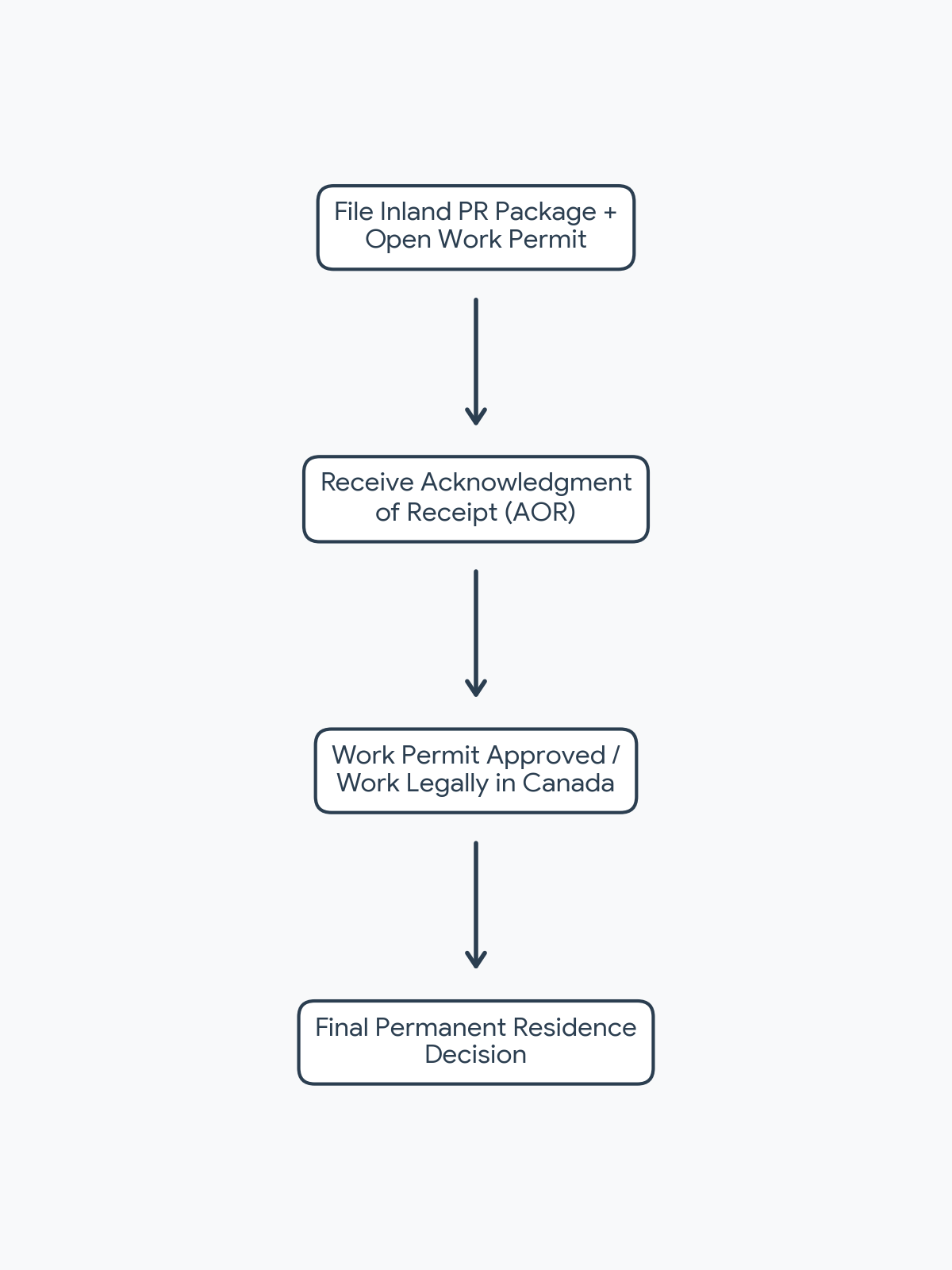
The overall inland spousal sponsorship timeline includes submitting your file, receiving your Acknowledgment of Receipt (AOR), undergoing medical and biometrics exams, securing the open work permit, and completing final background checks.
If you are wondering how to apply for an inland spousal sponsorship in Canada, the process involves compiling your PR application forms, proof of relationship, and work permit request into a digital package through IRCC’s online permanent residence portal.
Understanding Outland Spousal Sponsorship in Canada
An outland spousal sponsorship application to Canada is processed under the traditional Family Class. This is the standard route used when the sponsored person lives outside of Canada.
Surprisingly, you can also choose outland processing even if your partner is currently visiting you in Canada, if such visit is allowed. Why would a couple in Canada pick Outland? Travel flexibility and legal appeal protection.
Under the outland stream, if your spouse needs to travel back home for a family emergency or work commitments, leaving Canada does not automatically destroy the application.
Additionally, outland applicants who are physically staying in Canada with a valid temporary status can still apply for an open work permit once they receive their official AOR letter from IRCC.
Outland Spousal Sponsorship: Timelines and How to Apply
The outland spousal sponsorship processing time varies based on which overseas visa office handles the applicant’s file, but it generally ranges from 12 to 16 months – as of August 18th, 2026, it is at 17 months.
Your outland spousal sponsorship timeline begins with sponsor approval in Canada, after which the file is routed to the appropriate visa office abroad for background reviews and relationship checks.
Learning how to apply for outland spousal sponsorship in Canada requires gathering civil documents from your partner’s home country, assembling proof of a genuine relationship, and submitting the application through IRCC’s permanent residence portal under the Family Class category.
Comparing Inland vs. Outland Sponsorship Features
Choosing between these two routes shapes your daily life while you wait. The summary below contrasts the core legal and practical rules of each pathway.
| Feature | Inland Sponsorship (In-Canada Class) | Outland Sponsorship (Family Class) |
| Applicant’s Location | Must live in Canada with the sponsor. | Lives abroad OR living in Canada temporarily, if your spouse has a right to enter into Canada as a visitor. |
| Travel Outside Canada | Not recommended; re-entry denial cancels the file. | Flexible; travel does not cancel the application. |
| Open Work Permit | Yes, can apply at the same time as PR submission, only if your partner has a legal status in Canada. | Yes, if the applicant lives in Canada and has an AOR. |
| Right to Legal Appeal | NO appeal right to the Immigration Appeal Division. | YES, right to appeal a refusal to the IAD. |
The Critical Difference: Can You Appeal Inland Spousal Sponsorship?
When couples ask us, “Can you appeal an inland spousal sponsorship if IRCC rejects the file?”, the stark legal answer is no. You do not get an appeal to the Immigration Appeal Division (IAD).
Under Section 63(1) of the Immigration and Refugee Protection Act (IRPA), the formal right to appeal a sponsorship refusal belongs strictly to sponsors in the Family Class (Outland) stream.
If an outland application is refused, you can appeal to the IAD. An independent tribunal member re-evaluates your case, and you are allowed to present fresh, updated evidence proving your marriage is authentic.
If an inland application is refused, there is no appeal to the IAD. Your only legal recourse is asking the Federal Court of Canada for a Judicial Review. Judicial review is narrow, strict, and expensive. The judge only checks if the officer made a legal mistake; you cannot introduce new evidence to prove your love.
This legal distinction is why filing an inland application with missing documents or confusing relationship gaps is so dangerous.
How to Choose the Right Pathway for Your Sponsorship
Every couple has a unique background. Some couples met while working abroad, others met while studying at university here in Waterloo, and some are navigating complicated immigration histories.
An inland application is often wonderful for couples who are already living together in Canada, do not plan to travel abroad for a year or two, and need an open work permit to build financial stability.
An outland application is usually the superior strategic choice if your spouse is living overseas, if your partner travels frequently for work, or if your relationship history has complex details that make having a full legal right to appeal a necessary safety net.
Getting your sponsorship right the first time spares you years of heartache and financial exhaustion.
How the Jennifer Roggemann Law Office Can Help
At the Jennifer Roggemann Law Office, we treat your family sponsorship with the meticulous care it deserves. My faith motivates me to serve every client wholeheartedly, helping spouses navigate complex paperwork so they can focus on their future together in Canada.
We deliver real, actionable legal strategy right from our very first meeting. We sit down with you in our Kitchener office or over Zoom, review your timeline, identify potential red flags, and guide you toward the exact sponsorship category that protects your home.
See what our past clients have to say about us
Reading about processing times and legal hurdles is one thing. Actually surviving the wait is another beast entirely. We know the Canadian immigration journey takes a massive emotional toll on couples, and sometimes you just need to know that there is light at the end of the tunnel. But please, do not just take our word for it:
“I had tried to sponsor my husband before when I lived in another city. When my application was refused, I didn’t know what to do. The person who had assisted me with my application, helped me search online for a lawyer in my new city and I decided to spend the money on a consultation with Jennifer.
Lawyers are expensive but I didn’t see anything but my need to have my husband here with me. After that first meeting, I had something I hadn’t had in a long time – hope. Jennifer explained everything to me, how it wasn’t going to be easy, but it was possible. I decided to hire Jennifer to help me. It seemed to take a long time to get all my documents ready to file but after we filed, the process seemed really quick. They prepared us for an interview, as we knew that we would have one because we’d applied before.
This time, our interview went really well and within 11 months of us filing, including our interview, my husband is now here beside me. Jennifer and her team really cared about me and my husband as people, not just clients. They helped me see to my health and gave me hope – which was the best medicine they could give. Everyone in the office really wanted to help us and they made the process as easy as possible.
It is a lot of money, so it depends on your situation if you can hire her. However, at least go and get accurate information so that you can decide what’s best for you.
Now that my husband is here, our life can begin. We want to have a family and start our dreams together of a small house, children and to be happy with my family. Thank you Jennifer and team for helping us make that happen.”
Whether you need help choosing between inland and outland options or want an experienced immigration team to handle your entire application from start to finish, we are here to shoulder the heavy lifting.
Ready to bring your spouse to Canada?
Don’t leave your family’s future to guesswork or confusing government web pages. Contact the Jennifer Roggemann Law Office today to book your consultation, and let us help you build a clear, stress-free path to permanent residency.